Climate Change Report 2025
Climate Change Report 2025
Across the transport network, we’re already experiencing the effects of changing weather patterns caused by climate change. We need to prepare for more extreme weather in the future and find ways to minimise the impact on our people, our customers and the public services we provide.
In 2020, transport was responsible for 15% of Welsh greenhouse gas emissions. The UK Climate Change Committee has proposed a carbon reduction pathway to achieve net zero in Wales where emissions from transport (excluding plane travel) need to be roughly halved by 2030.
We’ll support the reduction of greenhouse gas emissions from transport in Wales through increasing opportunities for modal shift from private vehicles to public transport and active travel. We’re enabling this shift through the provision of more environmentally-friendly services and increased public transport infrastructure. We’re committed to supporting the Welsh public sector target of net zero by 2030.
In accordance with the Companies Act 2006, as amended by the Companies (Strategic Report) (Climate-related Financial Disclosure) Regulations 2022, this Strategic Report includes our climate-related financial disclosures, aligned with the recommendations of the Task Force on Climate-related Financial Disclosures (TCFD).
We have assessed climate to be a principal risk to the organisation, primarily because of the risk of disruption due to an increase in extreme weather events.
Governance
This section addresses our governance framework, outlining key structures, policies and strategic objectives that guide our organisation. Effective governance is fundamental to ensuring accountability, transparency and sustainable decision making. The following table outlines our governance model and each tier’s roles and responsibilities in relation to managing climate-related issues.
| Committees | Roles, Responsibilities and Activities |
| Transport for Wales (TfW) Board | The Board oversees and monitors progress against goals and targets, both directly and via the sub-committees. Our Audit and Risk Committee, reports against TfW’s climate risk appetite are disclosed to TfW Board on a six monthly and annual basis. This enables our Board to oversee and provide scrutiny of decisions that may impact the corporate risk appetite in line with TfW’s Risk Matrix. The Board is fully committed to ensuring that Welsh Government’s ambitions on climate change are met, including decarbonisation targets to respond to the climate emergency and adapt to the changing climate. We are committed to building resilience to the effects of climate change on public transport in Wales. |
| Executive Leadership Team (ELT) | The ELT Ensures that climate risk is embedded into corporate strategy and business planning. Monthly Strategic Risk Reports and presented to TfW Board and Executive Leadership Team for ongoing monitoring and management, strategic risks have an assigned responsible ELT Member who provides ownership of the risk, and mitigations. |
| The Audit and Risk Committee (ARC) | The ARC monitors our internal controls for managing climate change risks and opportunities, including transition risks and those impacting the delivery of objectives outlined in the Climate Adaptation and Resilience Plan and those that will be outlined in our Energy Strategy and Carbon Management Plan. |
| The Major Projects Committee (MPC) | The MPC provides governance and oversight of major decarbonisation, energy, and climate adaptation projects, including associated investments. The Climate Change Steering Group reports to the MPC on an ad hoc basis. Any major resilience projects or those focused on carbon abatement of energy requiring additional capital investment, will be referred to our Investment Committee for decision-making, following the presentation of a business case for each scheme. |
| Health, Safety, and Sustainability and Wellbeing (HSSW) Committee | This Committee monitors compliance with relevant energy and climate change legislation, standards, and systems. The Committee receives quarterly reports on progress to deliver on TfW’s carbon, energy and climate adaptation, resilience strategic objectives, and associated investment decisions. The Committee also oversees progress in delivering our strategic objectives related to carbon, energy, climate adaptation, resilience, and any associated investment decisions. |
| Climate Change Steering Group (CCSG) | The CCSG provides oversight alongside and accountability for the work of the Climate Change Adaptation Working Group (CCAWG). The CCSG is also responsible for providing oversight and advice regarding investment decisions relating to decarbonisation, energy management and/or climate adaptation. As well as providing an effective assurance function, the CCSG maintains consistency in ways of working across the two reporting working groups. The CCSG has cross-organisational representation. Meetings are held monthly. The Steering Group reports on TfW's Climate Risk Appetite quarterly and annually to the Audit and Risk, and Health, Safety, Sustainability and Wellbeing Committees. |
| CVL Climate Adaptation Working Group (CVL CCAWG) | The CVL CCAWG meets monthly and reports into the CCSG on its activities and progress. The CCAWG reports on the risks and opportunities relating to matters of both climate resilience and adaptation, as well as energy efficiency and carbon reduction of TfW operations and services. |
Strategy
We recognise the importance of identifying and managing climate-related risks and opportunities to ensure the long-term sustainability of our operations which align with Wales’s climate goals. We’ve developed a Climate Adaptation and Resilience Plan (CARP) which details how we will assess and manage climate risk across our Core Valley Lines (CVL) network, infrastructure and operations. The CARP provides us with a strategic roadmap for mitigating our vulnerability to physical climate risks in accordance with our remit from Welsh Government, which is “to ensure all TfW operations delivered on behalf of the Welsh Ministers are designed and delivered based upon the latest data on climate change risk and impacts and robust climate change adaptation plans are in place.” The CARP aims to increase the resilience of all our transport networks and operations, including any potential additional travel services that come under the TfW umbrella in the future.
Our Corporate Strategy outlines key priorities and objectives to challenge and overturn longstanding transport behaviours by changing the perceptions of public transport and enabling modal shift.
The main climate risks we face include physical climate hazards resulting from adverse weather and their effects. Our assets and operations are facing risks from:
- Rainfall: Heavy rain affecting drainage and earthworks
- Flooding: River and coastal flooding damaging assets and disrupted services
- Temperatures: Extreme temperatures impacting infrastructure and health.
- Storms and wind: Severe weather rendering routes unsafe.
- Cascading risks: Multiple hazards compounding safety and service disruption.
We’re assessing climate risk across our assets and services for high and very high levels of global warming across multiple time periods. Over the past few years, organisations within the rail industry have been working increasingly closely together on climate change adaptation to support each other, share lessons and build resilience to climate change within the railway system to maintain current and future passenger safety. This includes collaborating with Network Rail to set investment priorities and share learning at climate adaptation pathways workshops, as well as sharing learning and contributing to industry guidance as part of various adaptation working groups. Examples include the Infrastructure Operators Adaptation Forum and contributing to a study led by the National Infrastructure Commission in developing the UK Climate Change Risk Assessment 4 (CCRA4).
In October 2023, members of the UK Rail Industry CCAWG met to develop an implementation plan for a roadmap developed through the Climate Change ‘Adaptive Capacity’ Maturity Assessment project. The project proposed a set of 15 recommendations for collaborative activities to support climate change adaptation within the rail industry. The top priority recommendation was to adopt unified climate change scenarios across the rail sector risk assessment, asset design and strategic planning. The Rail Industry CCAWG has chosen Representative Concentration Pathway (RCP) 6.0 as the high warming default scenario, balancing expected emissions reductions under the Paris Agreement (2°C target) with current levels. RCP8.5 will be used to stress test assessments and determine if greater resilience is needed for long-term assets in a very high global warming scenario.
These scenarios were chosen to:
- Ensure consistency across the rail sector in risk assessments and strategic planning.
- Reflect both realistic and worst-case climate futures, supporting robust adaptation planning.
In August 2024, we commissioned a Rapid Adaptation Pathways Assessment (RAPA) to assess the range of climate risks our CVL infrastructure may be subject to, and highlighting potential adaptation pathways to mitigate these risks.
The RAPA identified key risks under RCP6.0 and RCP8.5, including:
- Increased frequency of extreme rainfall events, leading to flooding and landslips.
- Higher summer temperatures, increasing the risk of track buckling and overhead line failures.
- Vegetation growth and soil instability affecting embankments and cuttings.
Adaptation pathways were prioritised based on risk severity, cost-effectiveness, and implementation feasibility.
In April 2025, we completed the Adaptive Capacity Maturity Matrix to determine our current adaptation maturity level. We currently sit at a level of 2-3 out of 5; suggesting we are strong in governance and strategy for climate resilience and adaptation. Our next steps to improve our maturity level and adaptive capacity involve embedding and implementation of our strategy across the organisation.
The outcomes of the RAPA and maturity assessment have directly informed our strategic planning:
- Governance and strategy: We are currently at a maturity level of 2–3 out of 5, indicating strong governance and strategic intent, with further work needed on implementation and operational integration.
- Operational planning: Climate scenarios are now embedded in asset management plans and design standards.
- Investment planning: Adaptation measures such as improved drainage systems, heat-resilient materials, and vegetation management are being incorporated into investment programmes.
- Organisational development: Training and awareness programmes are being developed to embed climate resilience across all functions.
Climate-related risks and adaptation costs are being integrated into our long-term financial planning and capital allocation processes. Where relevant, provisions for climate adaptation are disclosed in our financial statements, and scenario analysis informs asset valuation and impairment testing. Future investment decisions will be assessed against both RCP6.0 and RCP8.5 scenarios to ensure financial resilience under a range of climate outcomes.
Climate Adaptation, Resilience and Risk Management
We’ve adopted a structured Climate Change Risk Assessment (CCRA) Framework to systematically evaluate and manage climate-related risks across our operations. Aligned with the latest UK climate scenarios, the framework integrates with our corporate risk matrix to ensure consistency in decision-making.
Supported by detailed guidance and an intuitive assessment tool, the CCRA enables targeted evaluation of risks to individual assets and systems. This proactive approach enhances organisational resilience, safeguards passenger safety, and informs strategic investment in adaptation measures. It has also increased engagement across the wider organisation. The framework and its accompanying guidance have been embraced by both internal and external stakeholders, including infrastructure operations, asset management, and elements of our supply chain. This has enabled our stakeholders to conduct climate change risk assessments of their own; by providing adequate tools, guidance resources, and learning materials to better understand the risks and opportunities brought on by a changing climate.
At an operational level, we conduct comprehensive CCRAs to evaluate the potential impacts of weather-related hazards on our organisation and customers. These assessments consider the frequency, likelihood, and severity of various climate threats, drawing on historical data to understand the extent of past disruptions - such as service delays, asset damage, and financial losses and identify future risks.
As well as existing hazards and past consequences, the climate change risk assessments use UK Climate Projections (published by the MET Office) to determine the approximate time period, severity and scale of future climate risk. This includes probabilistic projections for weather variables such as rainfall intensity, river flows, wind velocity and seasonal temperatures. These variables may be presented as an annual average, or a peak annual value for a more conservative assessment of risk. This data is used to assess what control measures will be required to reduce the impacts and consequences in each time period. Short term reflects present day from 2020 – 2040. medium term reflects 2040 – 2060, and long term reflects 2060-2080+.
While the organisation-wide CCRA Framework has significantly advanced our understanding of climate risk, there remains uncertainty around the timing of required adaptation investments - specifically, when assets may fail under future climate scenarios. To address this, TfW is developing climate adaptation pathways.
This approach supports strategic and flexible decision-making by identifying key trigger points for action. It helps balance the risks of premature investment against the consequences of delayed response, ensuring that apt adaptation measures are implemented at the most effective and cost-efficient times.
We’ve been working with specialists to develop adaptation pathways for the CVL, informed by our climate risk data. Using the outputs from these pathways, we can prioritise focus areas for action and investment within a Climate Adaptation Delivery Plan, supported using the BS 8631: Adaptation to Climate Change framework. CCRAs are conducted on our assets and activities that are vulnerable to the impacts of climate change (e.g. extreme weather) including:
- New assets (e.g. track, stations, signalling equipment)
- Asset renewals/upgrades
- New transport services
We’ve undertaken CCRAs across a number of sites to evaluate risks associated with extreme weather and other climate-related hazards. These assessments involve on-site inspections of locations previously affected by adverse weather, focusing on the extent of damage, disruption to services, and the condition of physical assets. In addition to asset condition, the assessments consider a range of operational and safety factors, including potential adaptation measures, employee and passenger safety, and service quality - such as comfort, punctuality, and hygiene.
To complement these field assessments, desk-based CCRAs are also underway for multiple CVL stations and depots. These provide a more detailed, data-driven analysis of climate risks, ensuring a comprehensive and evidence-based approach to resilience planning across our infrastructure network.
Completed surveys include:
- Cardiff Bay
- Radyr
- Taff’s Well
- Trefforest
- Trefforest Estate
- Pontypridd
- Porth
- Llandaf
- Mountain Ash
- Canton (Depot)
We evaluate climate-related risks and opportunities using our organisational Risk Appetite Matrix, ensuring alignment with our broader risk management framework. Outputs from CCRAs are integrated into our existing risk processes and monitored through the Active Risk Manager (ARM) system.
Risk Owners - those accountable for specific assets or projects - are responsible for regularly reviewing climate risks and implementing appropriate mitigation measures. Where risks exceed agreed thresholds, they are escalated to the CCRG for further evaluation and action. The frequency of risk reviews is tailored to the nature and timeframe of each risk. Short-term risks may require more frequent monitoring, while long-term or strategic risks are reviewed periodically to ensure continued relevance and alignment with our evolving climate risk profile.
To support transparency and informed decision-making, we’ve developed an interactive dashboard that visualises completed CCRAs by geographic location. This tool enhances organisational visibility and supports reporting to Board committees, helping to align investment priorities with our climate risk appetite. Periodic reassessments - at least every five years - ensure that risk ratings remain accurate as our understanding of climate impacts in Wales evolves.
Our Risk Management team plays a central role in embedding climate-related risks and opportunities into day-to-day operations. The ARM system is used to record and monitor any climate risks and opportunities identified from CCRA's. Such risks may include potential knock-on effects to other business areas such as financial performance, transport planning, assets, and customer experience. The risk management team communicate these risks to other teams/departments as necessary, including assigning action owners for monitoring the risks, and implementation of mitigations. These are followed up by monthly meetings to re-assess the impacts of the risk (potential and real) and progress of the mitigations.
These risks are scored using both qualitative and quantitative assessment criteria, such as likelihood, potential cost of impacts, and similar examples of previous materialisation. The latter may include financial impacts, service disruption and asset damage resulting from extreme weather events that have occurred in the past. The CCRA’s consider the severity, likelihood and frequency of potential consequences, informing how we prioritise the highest risks to be managed first. This is especially true for safety-critical assets and key services routes on our network.
A summary table of our core strategic climate risks and associated mitigation controls is provided below.
We’ve also embedded the CCRA framework into our Programme Management Office (PMO) processes. All new capital projects are required to assess climate risks and opportunities at the pre design stage. This ensures early identification of risks, reduces exposure, avoids long-term lock-in, and supports the delivery of climate-resilient infrastructure. The climate change & energy team is consulted for input to capital projects, calling on relevant subject matter experts to provide perspective and insight on climate risks pertinent to their business function. This involves working with other departments to consider what risks may be shared, or potential cascade risks between us. The CCRA framework is used to encourage early adoption of resilience & adaptation thinking, including effective embedment within project governance and decision-making processes.
As we transition to a low-carbon economy, we recognise the emergence of speculative risks and opportunities. These include potential impacts on operations, financial performance, and service delivery. For example, the expansion of electrified assets or the shift from diesel to hydrogen fuel in our bus fleet introduces new vulnerabilities. These include increased exposure to extreme weather events - such as intense rainfall, temperature fluctuations, and storm damage - and uncertainty around the performance and reliability of new materials, fuels, and technologies.
To reduce our exposure, we’re developing a Climate Adaptation and Resilience Delivery Plan, which includes asset maintenance and renewals scoring for the CVL network. This plan prioritises critical infrastructure such as drainage and earthworks, ensuring a more strategic and proactive approach to resilience.
Financial Impact
We’re working to establish a robust approach to assessing the financial materiality of climate-related risks and opportunities. While this work is still in its early stages, it forms a critical component of our long-term climate strategy.
Our current focus is on building the internal capacity, data infrastructure, and analytical tools needed to quantify both acute physical risks (e.g. storm-related service disruptions) and chronic risks (e.g. long-term asset degradation due to climate change). We also aim to assess transition risks, such as policy shifts, supply chain volatility, and the financial implications of decarbonisation.
Significant CVL disruption caused by extreme weather events can result in a loss of revenue, depending on the level of disruption, we can expect losses of £100,000-£500,000 per day. The impact on customers and local businesses in terms of social economic impacts can be far greater.
For Wales and Borders Network Rail have a financial mechanism that compensates us for unplanned service disruptions caused by factors outside of our control (including storms).
To strengthen our financial materiality assessment, we’re taking the following steps:
- Integrating climate risk scenarios into financial planning and investment appraisals.
- Developing internal metrics and KPIs to track climate-related financial exposure and resilience outcomes.
- Collaborating with partners to improve data sharing and modelling of climate impacts.
- Embedding climate risk into commercial risk management, ensuring alignment with our Risk Appetite Matrix and Active Risk Manager (ARM) system.
Principal Risk
Our most significant climate-related risk and the most material is weather related, as detailed on page 40 of the Annual Report and below.
Extreme weather events
| Risk Description | |
| Continued risk of major disruption to the network caused by extreme weather events such as flooding, heavy snowfall, sustained high temperatures and storm force winds. | |
| Mitigation actions | Progress |
Joint seasonal disruption programmes and strategies. Monitor weather warnings and forecasting. Vegetation management and assessment of dead, dying and diseased trees. Review of flood sites and remediation programmes. Allowing season rail tickets to be used on other nearby lines and maintaining agreements with bus operators. Climate change risk assessments and adaptation plan. | Seasonal change and preparation meetings in place with Train Operations and Infrastructure Managers. Rail replacement services have been contracted. Development of the TfW climate resilience and adaptation plan. |
| Speed of potential impact: | Less than three months. |
Table of Risks
| Risk Term | Risk | Impact | Mitigation Control |
|---|---|---|---|
| Short Term | Extreme weather events (flooding, extreme heat, ice, snow) may cause disruption to infrastructure which could have operational and cost implications. | Inability for TfW to maintain service provision and deliver on Welsh Government’s (WG’s) Remit requirements, with cost implications / financial implications due to accidents, asset damage and service disruption | Future-proof mitigation (e.g. construction) and pre-work environmental assessments. Continue to conduct risk assessments across the network to ensure climate change risks are captured and appropriate mitigations are in place for future occurrences. Set up governance channels for monitoring our progress to enhance our adaptive capacity to climate change-induced extreme weather events. |
| Short Term | The decarbonisation target of net zero by 2030 may not be met if diesel trains are unable to be refurbished or repurposed | This could have reputational, legal, and cost implications and mean that commitments are not met | This will be managed through the Rolling Stock Decarbonisation Strategy |
| Short Term | Failure to deliver on 2030 net zero target due to supply chain emissions | This could affect TfW’s ability to reduce its corporate emissions and WG’s Remit requirements. | In collaboration with Procurement and Finance the Climate Change Team will conduct an in-depth analysis of supply chain emissions to obtain more accurate representation and add this to offset higher level reporting and collaborate with Welsh Government to develop a hybrid approach to carbon accounting for this activity. We’re taking part in a pilot for a supply chain reporting tool with other Welsh public bodies. |
| Medium Term | Failure to deliver on net zero target due to development on greenfield land assets. | Our transformation programme could result in development of our greenfield assets, which could reduce the sequestration potential of the land we own. This could reduce the offset potential of our land assets, as they could become an overall net source of emissions, rather than a sink. We may then have to buy other offsets to compensate | Work with our land management, engineering and projects teams to ensure that due diligence is done when considering development of any TfW land assets. Develop governance structure for stakeholder consultation on land purchases/assets. |
| Medium & Long Term | Risks to assets, health and safety, reputation and costs due to absence of impact assessments, appropriate response plans and policies associated with extreme/adverse weather | Potential damage and premature failure of assets Increased disruption to services and financial impacts of asset repair, delay compensation and other losses | Work collaboratively with infrastructure owner team to develop impact assessments for extreme/adverse weather events and share learning. Set up extreme weather working group to coordinate development of appropriate extreme weather response plans and policies. Publish TfW extreme weather guidance for staff and customers to reduce the risk of weather-related impacts on health, journeys, assets, and ways of working. Coordinate the development of contingency plans with the asset management team. This includes implementing asset protection measures and renewals on CVL infrastructure |
Table of Opportunities
| Opportunity Term | Opportunities |
| Short Term | We’ve expanded our role in supporting electric vehicles (EVs), zero-emission buses and taxis, and active travel initiatives. If successfully implemented, our efforts could significantly reduce the carbon footprint of Wales, promoting cleaner and more sustainable transport options across the region. |
| Medium Term | Improved public transport services and increased availability of EV charging points could result in significant modal shift. |
| Medium Term | The completion of the South East Wales Metro could further significantly increase the extent of modal shift. |
| Medium Term | We’re exploring opportunities to develop our own renewable energy portfolio, such as thin film solar and trackside renewables, in partnership with key stakeholders. By increasing the use of energy-efficient solutions like LED lighting, we aim to reduce reliance on the national grid, enhance resilience to extreme weather, and drive sustainability across our operations. |
| Medium to Long term | The development of the North and South West Wales Metros could further significantly increase the extent of modal shift. |
| Long term | There is an opportunity for us to create a transport network that is resilient and operational in the face of future climate change impacts. |
| Long term | There is an opportunity for us to reduce costs associated with accidents, asset damage and service disruption caused by extreme weather events through the delivery of our CARP. |
Collaboration
Tackling climate change requires a collective effort, and we’re working collaboratively with key stakeholders to develop effective, long-term solutions. By sharing expertise and aligning strategies, we can reduce emissions, enhance resilience, and support sustainable development across Wales.
One of our closest partners is Network Rail (NR), who own the majority of rail infrastructure in Wales. Together, we are enhancing the climate resilience of the Welsh railway through shared data, joint planning, and coordinated action. While we develop climate adaptation pathways for our critical assets, NR is conducting CCRAs across the Wales and Borders network. We’re also collaborating on decarbonisation initiatives to reduce emissions and support a more sustainable railway.
Since assuming ownership of the CVL in March 2020, we’ve worked closely with Amey Infrastructure Wales (AIW), our delivery partner. AIW supports climate resilience through the development of Extreme Weather Plans (NR/L3/CIV/190) and contributes to strategic asset management. This includes producing annual Asset Management Plans (AMPs) and implementing the Strategic Asset Management Plan (SAMP), which focuses on improving asset knowledge and resilience - particularly for drainage, structures, and earthworks.
A key initiative under the CARP is the development of a Vegetation Management Plan (VMP), published in autumn 2024. This plan addresses seasonal challenges, such as autumn leaf fall, to improve service reliability and operational resilience.
We utilise Geographic Information Systems (GIS) to map CVL assets in relation to flood zones, using data from Natural Resources Wales (NRW). We’re currently conducting a detailed study on river flooding and its potential impacts on the CVL network, aiming to identify vulnerable areas and develop targeted resilience strategies.
Ongoing discussions with NRW and Dŵr Cymru Welsh Water aim to establish a Memorandum of Understanding to support joint resilience planning. This collaboration will enhance asset knowledge and enable a more unified response to climate risks - particularly those that are cross-organisational or compounding in their nature.
We’re an active member of several cross-disciplinary Climate Change Adaptation Working Groups, including those led by UK infrastructure bodies and Public Services Boards in Cardiff, the Vale of Glamorgan, and Cwm Taf Morgannwg. These partnerships are vital for driving coordinated, region-wide adaptation strategies.
Metrics and targets
We’re committed to aligning our climate resilience and adaptation efforts with Welsh Government objectives. We recognise that addressing climate-related risks and opportunities requires robust governance, strategic foresight, and measurable progress.
In line with the Welsh Government’s Prosperity for All: A Climate Conscious Wales and the Wales Resilience Framework 2025, TfW is working to embed climate resilience across its operations, infrastructure, and decision-making processes. These national strategies emphasise the need for public bodies to build adaptive capacity, reduce exposure to climate hazards, and protect vulnerable communities.
TfW’s Annual Business Plan reaffirms our commitment to delivering the objectives set out in our CARP. This includes strengthening the resilience of our network and services and ensuring that climate considerations are embedded in all major programmes and investments.
While we have made progress in establishing initial targets and indicators, we acknowledge the need to develop a more comprehensive suite of quantitative and qualitative metrics. These will align with the evolving nature of climate risks and opportunities and support transparent reporting.
Our current focus is on:
- Refining methodologies for assessing climate impacts and adaptation effectiveness.
- Enhancing data collection to support evidence-based decision-making.
- Developing KPIs that reflect both physical and transition risks, as well as resilience outcomes.
- Establishing monitoring and evaluation routines to track progress against baselines and inform future investment.
A key deliverable in this area is the development of our Weather Resilience and Climate Change Adaptation Strategy, which will provide a structured approach to tracking performance and aligning with both national and international climate disclosure standards.
| Risk Term | Commitment | Our objectives and targets | |
| Welsh Government targets and commitments | Short Term | By 2030, choosing zero carbon will be routine, culturally embedded and self-regulating across the Welsh public sector. | 100% renewable energy on CVL Scope 1 emissions (traction) CVL: make significant reductions of Scope 1 emissions by 2024, with a focus on attaining a 100% reduction. |
| Medium term | Increase trip mode share of public transport from a current estimated proportion of 5% to 7% by 2030 and 13% by 2040. | In our 2022-27 Sustainable Development Plan we have committed to promoting sustainable travel and reducing the need for private car use. The full objectives to support us deliver on this aim are outlined in the below plan. Sustainable Development Plan | |
| Industry targets | Medium term | Phasing out of diesel-only trains by 2040 | Scope 1 emissions (traction) CVL: make significant reductions of Scope 1 emissions by 2024, with a focus on attaining a 100% reduction. |
| Long term | Network Rail have committed to achieving net zero carbon emissions by 2050 in England and Wales. |
Carbon emissions Report
Governance
We account and report our annual carbon emissions in line with the Welsh Government Reporting Requirements which is consistent with globally accepted standards. The guidance has been developed to support Welsh public sector bodies reduce collective emissions to net zero by 2030.
Our Carbon Management Plan and associated carbon targets are in development; however, we report our rolling stock carbon intensity (grams of carbon dioxide equivalent per passenger km) every four week financial period. This is measured and compared against the same period the preceding financial year. We also report on our annual rolling stock carbon intensity.
Strategy
We’re committed to supporting the Welsh Government’s ambition for a net-zero public sector by 2030. Our strategy focuses on reducing operational emissions, improving energy efficiency, and transitioning to low-carbon transport services. Key strategic initiatives include:
- Carbon Management Plan: We’re developing a costed action plan to manage Scope 1, 2, and 3 emissions.
- Energy Strategy (to be published summer 2025): A roadmap for decarbonising our energy supply and improving energy efficiency across our estate.
- Energy and Carbon Improvement Plan, which outlines technical pathways for implementing low-carbon energy schemes and enhancing long-term operational resilience.
- Modal Shift and Electrification: Investment in electrified rail and low-emission bus fleets to reduce transport-related emissions.
We recognise that as our services expand and electrification increases, energy demand will rise. Our strategy therefore includes measures to reduce energy expenditure and emissions through renewable energy sourcing, energy audits, and infrastructure upgrades (e.g. LED lighting, insulation).
Our Scope 1, 2 and 3 emissions for financial year 2024/25
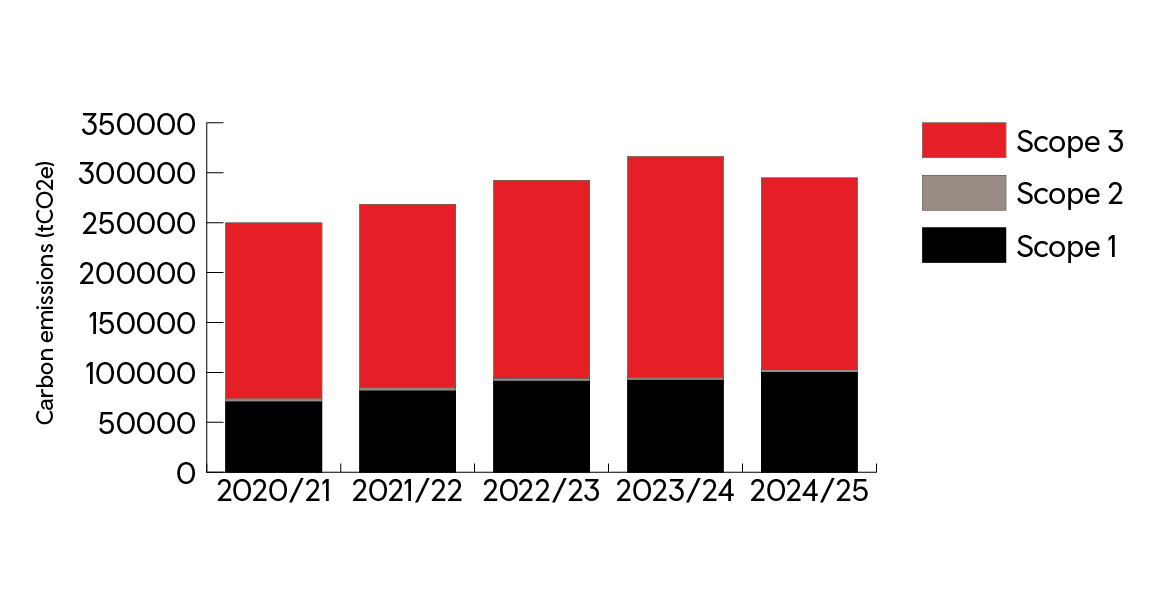
In comparison to our 2020/21 baseline, our operational carbon emissions have increased by 18%. The breakdown per scope is demonstrated in the following table. The uplift in our operational emissions during the last five years is attributed to our increased service provision and progressive spend on transforming public transport services in Wales.
| Scope | 2020-21 Emissions tCO2e | 2021-22 Emissions tCO2e | 2022-23 Emissions tCO2e | 2023-24 Emissions tCO2e | 2024-25 Emissions tCO2e |
| Scope 1 | 70,674 | 81,572 | 91,338 | 92,348 | 100,225 |
| Scope 2 | 2,647 | 2,736 | 2,514 | 2,060 | 2,453 |
| Scope 3 | 176,482 | 184,193 | 198,651 | 221,911 | 192,187 |
| Land Use Emissions | -689 | -702 | -757 | -591 | -565 |
| Out of Scope Emissions | N/A | N/A | N/A | 68 | 134 |
| Total | 249,114 | 267,799 | 291,745 | 315,796 | 294,434 |
The annual carbon intensity for total rolling stock emissions (Scope 1) was 81gCO2e/PAX km. Scope 1 emissions are those arising from activities within our direct operational control, in this instance fuel consumption by our trains. The carbon intensity of our rolling stock has reduced by 4% compared with 2023/24.
Our emissions decreased by 7% or 21,362 tCO2e in 2024/25 from 2023/24. 34% of our emissions were Scope 1, less than 1% from Scope 2 and 65% from Scope 3. The decrease in emissions this year compared with the previous year can largely be attributed to decreased supply chain emissions, namely the completion of major construction projects such as Taffs Well Depot and Cardiff Bus Interchange. We currently report on supply chain emissions based on spend data which can lead to significant variations in emissions year on year. The 2023/24 emissions have been updated to provide a like-for-like comparison to 2024/25.
Update on carbon targets
In 2019, we published our Low Carbon Impact Strategy which, includes the following targets for our carbon emissions, we were delayed in our achievement of these targets due to COVID19. This year we will publish new targets in our Carbon Management Plan:
| Scope | Target | Status |
| Scope 1 (CVL traction) | 100% reduction by end of 2023 | In progress - delays in delivery of the Metro due to the impacts of COVID19 |
| Scope 1 (Wales & Cross-Border traction) | 30% reduction by end of 2023 | In progress - 70% of all services are now operated on new trains. |
| Scope 2 | 100% reduction by end of 2023 | Achieved via 100% renewable electricity contract in 23/24 100% of our renewable energy was generated in Wales |
Reporting Enhancements
- To help us understand more about the emissions we produce, we have developed robust accounting and reporting processes for our carbon emissions in line with Welsh Government’s reporting guidance for the public sector.
- Emissions tracked every four weeks across electricity, gas, water, waste, fuel, and renewable generation.
- Commuting and homeworking emissions estimated via annual staff travel surveys and FTE-based modelling.
- Data submitted to Welsh Government for validation and benchmarking.
Summary and Next Steps
In summary, we have initiated an assessment of the potential impacts of future climate change on our owned assets and plan to broaden this work to include transitional risks. Our Adaptive Capacity Maturity Matrix serves as a valuable tool in identifying the necessary steps to strengthen our ability to adapt to climate change and build resilience against the risks we have identified.
Although we have made meaningful progress, further efforts are needed as we continue to develop our Weather Resilience and Climate Change Adaptation Strategy. This plan will open up opportunities for deeper engagement with stakeholders, promote a culture of awareness around climate resilience and adaptation, and embed these priorities into our organisation It will also empower individuals across the organisation to take ownership of climate-related challenges and opportunities. Through this collaborative approach, we aim to enhance our preparedness and adaptability in the face of a changing climate.
- Develop our Weather Resilience and Climate Change Adaptation Strategy.
- Finalise and publish the Carbon Management Plan (2025/26) which will include our new metrics, targets and KPIs.
- Launch the 2030 Energy Strategy to guide investment in renewable energy and efficiency.
- Implement the Energy and Carbon Improvement Plan to deliver low-carbon infrastructure projects.
- Continue collaboration with public sector partners to achieve collective net-zero goals by 2030.
List of Abbreviations
AIW - Amey Infrastructure Wales
ARC - Audit and Risk Committee
ARM - Active Risk Manager
BS - British Standard
CO2e - Carbon dioxide Equivalent
CAP - Climate Adaptation Plan
CARP - Climate Adaptation and Resilience Plan
CCAWG - Climate Change Adaptation Working Group
CCRA - Climate Change Risk Assessment
CCSG - Climate Change Steering Group
CVL - Core Valley Lines
EV - Electric Vehicles
FTE - Full-Time Equivalent
HSSW - Health, Safety, and Sustainability and Wellbeing
KPI - Key Performance Indicators
LED - Light Emitting Diode
MoU - Memorandum of Understanding
MPC - Major Projects Committee
NRW - Natural Resources Wales
NR - Network Rail
PAX - Passenger
PMO - Programme Management Office
RCP - Representative Concentration Pathway
REGO - Renewable Energy Guarantees of Origin
SMART - Specific, Measurable, Achievable, Relevant, and Time-based
TfW - Transport for Wales
UK - United Kingdom
WG - Welsh Government