The day Cardiff moved a river
As part of the Cardiff Central Enhancement Programme, we're taking a step back in time to explore the station's fascinating past and the landscape around it. Through blogs, videos and images, we'll show how this place has changed over hundreds of years.
In this second blog, we're looking at an incredible piece of engineering that made the very first station here possible changing Cardiff's geography and landscape forever.
Choosing the site
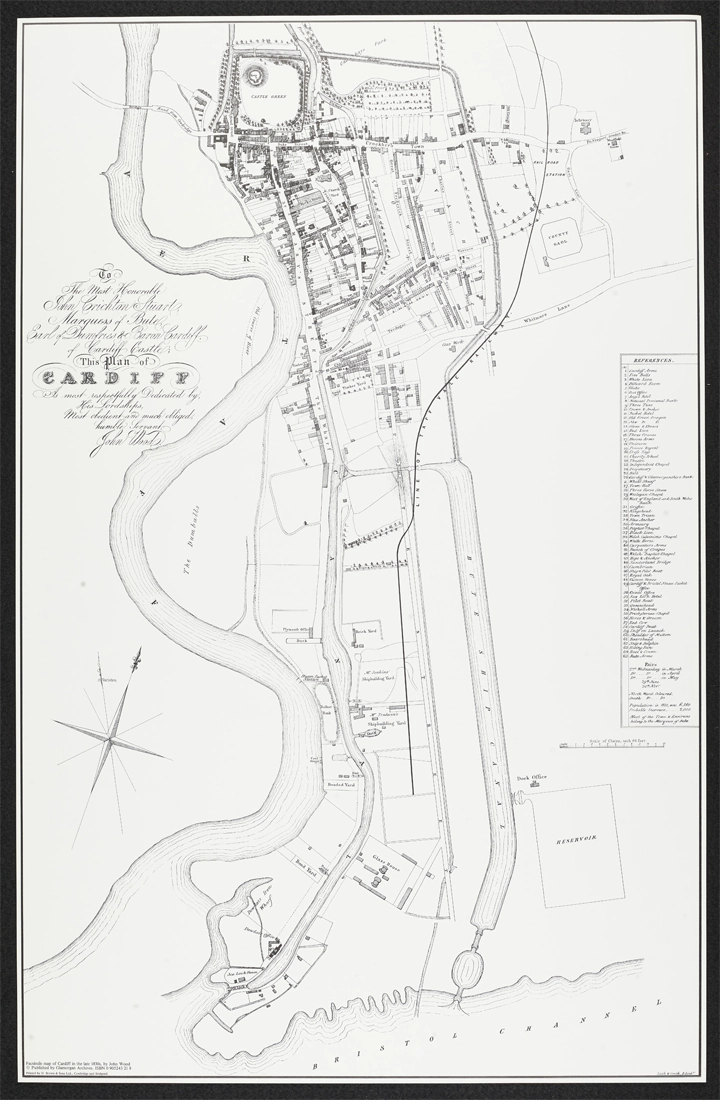
In the early 1840s, the South Wales Railway Company wanted to build a railway line from Gloucester to Swansea, passing through Cardiff. That meant Cardiff would need a main station, but finding the right place wasn't easy. The chosen site was far from ideal. It was low, often flooded and close to the tidal River Taff. Building a station there seemed almost impossible.
That's when a bold idea came in.
In 1849, the engineer Isambard Kingdom Brunel - one of the most famous engineers of his time- came up with a daring plan. Instead of working around the river, he proposed to move it!
Brunel diverted the River Taff, sending it further west. This created a dry, stable strip of land where the station could be built. This made it possible to build a station with tracks running east to west - ideal for the proposed railway line. It also helped to protect the area from flooding, which had been a constant problem. What's even more impressive is how this work was done. There were no modern machines or detailed science-based models. Instead, it relied on experience, basic tools, manual labour and early steam-powered equipment.
The diversion wasn't without its problems - the old course of the river becoming stagnant and smelly being one of them. Had this work not been undertaken, the South Wales Main Line, Cardiff Central railway station and much of the city centre we know today might not exist.¹
The first station opens (1850)
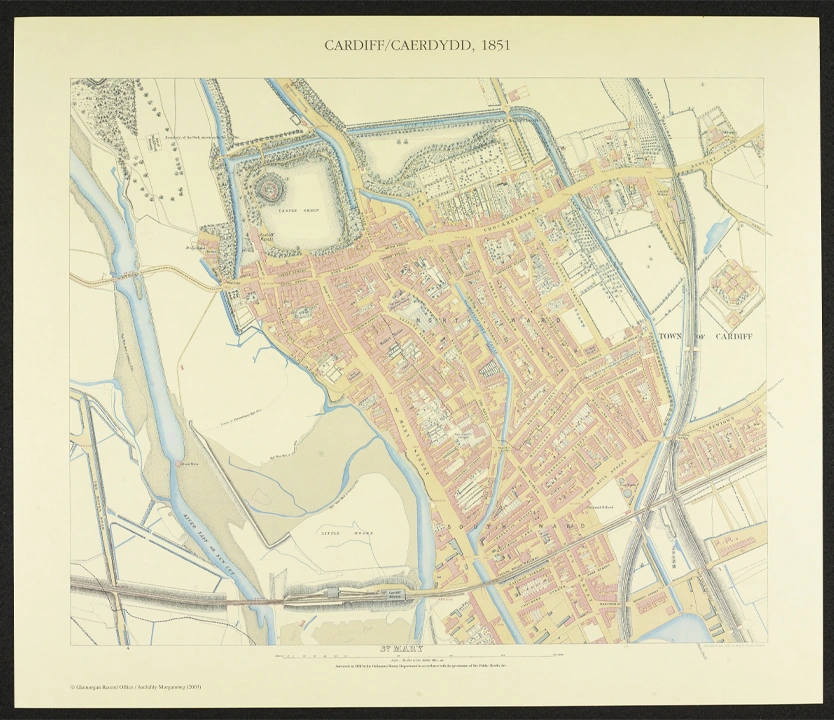
The station opened on 19th June 1850, simply called “Cardiff”.²
It was part of the South Wales Railway line between Chepstow and Swansea, built close to the Glamorganshire Canal and the docks. This location was key. It connected the railway with sea transport, making it much easier to move goods like coal from the South Wales valleys to ships in the docks. This shaped a powerful transport network that helped Cardiff grow into one of the busiest ports in the world.
1 'South Wales Railway', Morning Herald, 31st August 1849. See, for example, Engineer with the stamp of genius ... the man who shaped the nation - Wales Online, Cardiff Central railway station - History Points, and for an in-depth read and background, see, Stephen K. Jones, Brunel in South Wales, Volumes 2 and Volume 3, The History Press, 2006 and 2009.
2 The South Wales Mainline opened on the 18th with trains running through the station, but the 19th being the first day of revenue-generating service following the guidance in- Michael Quick, 'Railway Passenger Stations in Great Britain', Microsoft Word - MASTER WORD FILE for 5.05 u- WORKING FILE, page 119.
At first, getting to London was not straightforward. That changed in 1852, when a railway bridge opened at Chepstow. Passengers could now connect with the wider Great Western Railway network from Cardiff, making travel faster and easier across long distances.³
Based on the limited sources and descriptions available, the station in 1850 looked nothing like the Cardiff Central we see today. It was simple and practical. There were basic platforms with canopies, a small booking office, waiting rooms and areas for handling goods. It had four through tracks running through the site and consisted of two through platforms, each with its own bay platform.⁴
It was designed to do the job, rather than to impress as one article in the Cardiff Times described it:
"…in the continued existence of that inconvenient, dirty, mis-shapen, windy, cold-producing, and dangerous structure known as the Great Western Railway at Cardiff….Cardiff station is without a rival for the ugliness…"⁵
Even so, the placement of station here played a huge role in the transformation of Cardiff and what was to come.
A turning point for Cardiff
The opening of the station marked a major moment in Cardiff's history. It helped turn the city into an important railway hub, supporting industry and trade and fixing this location as Cardiff's main transport centre, just as it is today.
Brunel had not just built a station. He had moved a river, created new land and helped a city grow all in one! Today, the river still follows the course Brunel created.
Cardiff kept growing, though, and it soon became clear a bigger station was needed. One that could also connect to more lines and places.
In our next blog, we'll explore how the station expanded and evolved over the later 19th century and into the early 20th century on its journey to becoming the Cardiff Central we know today…
Join us as we continue the journey…
3 Brunel's original pillars still support the bridge, with the rail deck structure was replaced in 1962. Chepstow's Bridges - Chepstow Town Council
4 Ordnance Survey Map 1850 -1920, accessible via Ordnance Survey Maps Six-inch England and Wales, 1842-1952 - Map Images - National Library of Scotland. See also, 'The 1930s Rebuilding of Cardiff General Station' Journal of the Welsh Railways Research Circle, November 2021 Supplement Welsh Railways Research Circle - Journal
5 'Cardiff Railway Station', Cardiff Times, 21st November 1874