
The SNP process: From planning to delivery
The development of individual Station Network Plans (typically follows a structured process that aligns with both the Welsh Transport Appraisal Guidance (WelTAG) and Transport for Wales’ Plan of Works (PoW). These two frameworks provide complementary approaches to ensure that Station Network Plans are evidence-based, inclusive, and deliverable.
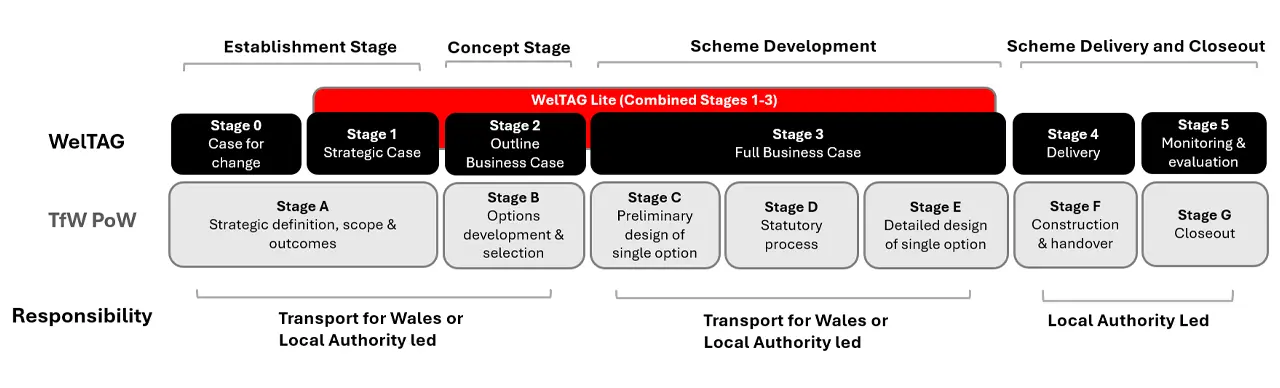
The diagram below illustrates the combined process flows of WelTAG and Plan of Works.
Roles and responsibilities: A collaborative approach
The Station Network Plan process is designed to be collaborative and flexible. To date, TfW has typically led early-stage development, offering planning expertise, technical input, stakeholder engagement and project management support in partnership with local authorities. At every stage, TfW can support with strategic prioritisation, design guidance, stakeholder engagement, monitoring and evaluation, and procurement advice, tailored to local needs and capacity.
TfW will work closely with local authorities and CJCs to align station and route selection with regional priorities and funding opportunities, such as those set out in the Regional Transport Plans (RTPs) and their Regional Transport Delivery Plans (RTDPs).
Local authorities are encouraged to make use of TfW’s support but may also choose to lead the process themselves. Regardless of who leads earlier stages, local authorities are best placed to take ownership of scheme delivery, particularly construction and close-out (WelTAG Stages 4+5 / PoW Stages F+G). As Highway Authorities, local authorities are best suited to this role due to their legal responsibilities, access to funding, deep local knowledge, and integration with planning and development frameworks.
This partnership model ensures each Station Network Plan reflects local priorities while benefiting from national coordination and expertise.
The process
1. Establishment stage
The initial stage, which aligns with WelTAG Stage 0+1 / PoW Stage 0+A and is typically led by TfW, sets the foundation for each Station Network Plan, including station and route selection, initial stakeholder engagement and early business case development.
Key activities and deliverables
- Station selection
TfW ranks stations based on their potential to support walking, wheeling, and cycling using the 2020 Sustrans "Propensity to Actively Travel to Stations" study. The study highlights stations where active travel improvements could have the biggest impact on shifting how people travel. This propensity assessment is then combined with existing TfW or local authority work programmes (such as service enhancements), the local Active Travel Network Map and close collaboration with local authorities and CJCs to align with regional priorities and funding opportunities within the Regional Transport Delivery Plans. This will then lead to a regional prioritisation of stations, agreed with the relevant CJC and local authorities, ensuring that selected locations reflect both strategic potential and deliverability.
- Route selection
Routes to selected stations are appraised using TfW’s Active Travel Network Maps prioritisation tool and other data sources, such as Welsh Index of Multiple Deprivation and Stats Wales collision data, and includes engagement with local authorities to consider local context. Focus is typically on routes rated as likely to have a “high” or “very high” impact in changing how people travel. This involves:
- Review of the Active Travel Network Maps database
- Stakeholder engagement
- Site visits for route audits (if required) and review of existing facilities
- Analysis of survey data and trip attractors.
- Memorandum of understanding
Local authorities are asked to formally outline their support for relevant schemes through a Memorandum of Understanding, which includes a tailored annex outlining roles and responsibilities of the various project partners.
- Strategic outline business case development
A long list of route options is developed using the Welsh Transport Appraisal Guidance five-case approach, demonstrating:
- Strategic fit: How the improvements align with broader goals.
- Well-being: The positive impact on the community.
- Affordability: The financial viability of the scheme.
- Management: Who will manage the scheme and its risks.
- Deliverability: How the different parts of the scheme will be procured and delivered.
Project governance
The Station Network Plan development process will be supported by a dedicated review group of each Station Network Plan, ensuring proposals are well-evidenced, regionally aligned, and read to progress. The group will include representatives from local authorities, CJCs and TfW. Acceptance of the proposals by the LAs will be required and must be recorded in order for schemes to progress through the development stages.
TfW has previously been responsible for setting up the review group during the establishment stage, in collaboration with the relevant local authority. The group acts as a steering and stage-gate panel, reviewing and approving key deliverables before each transition to the next phase.
Project execution plan
A key output of this stage will be a Project Execution Plan (PEP), outlining proposed routes and/or station improvements. This plan will be progressively refined through subsequent project stages, ensuring alignment with stakeholder priorities, technical assessments, and funding opportunities.
2. Concept stage: Options development and selection
Following the establishment stage, the concept stage focuses on options development and establishing a shortlist of route options, informed by engagement with the public and key stakeholders. This stage aligns with WelTAG Stage 2 / PoW Stage B.
Key activities and deliverables | TfW support at this stage |
| TfW typically leads this stage and can offer:
This support builds on regional delivery models already in use and can be tailored to local needs. |
3. Scheme development: Preliminary design and statutory process
This stage (WelTAG Stage 3 / PoW Stage C+D) focuses on the preliminary design of the single route option, refining technical details and preparing the scheme for detailed development. This stage also refines the available resources and funding.
Key activities and deliverables | TfW support at this stage |
|
Support is flexible and can be tailored to local needs and it can be delivered through TfW’s internal teams or external consultants. Local authorities may choose to lead this stage, with TfW offering advisory and technical input as needed. |
4. Scheme development: Detailed design
This stage (WelTAG Stage 3 / PoW Stage E) finalises the scheme design, ensuring it meets all technical, legal, and delivery requirements. The scheme is prepared for tender and construction.
Key activities and deliverables | TfW support at this stage |
|
|
Important note: When TfW has led on the scheme development stage (concept, preliminary, or detailed design), all deliverables will be formally transferred to the local authority at this stage, as the responsible Highway Authority. It is assumed that all internal approvals between departments have been secured by the LA to enable progression of the project through the various stages. The LA then assumes ownership of the documentation and is expected to progress the scheme in line with the Memorandum of Understanding and WelTAG requirements.
5. Scheme delivery: Construction and handover
This stage (WelTAG Stage 4 / PoW Stage F) focuses on the physical delivery of the scheme. As Highway Authorities, local authorities are typically best placed to lead construction and implementation.
Key activities and deliverables | TfW support at this stage |
| While local authorities usually lead delivery, TfW can still provide advisory support, but support can be scaled depending on local needs and available resources:
For successful delivery, WelTAG Stages 4+5 / PoW Stages F+G need to be completed, with all associated deliverables achieved. |
6. Monitoring and evaluation: Closeout
The final stage of closeout (WelTAG Stage 5 / PoW Stage G) comprises monitoring and evaluation, which are essential to understanding the impact of each scheme and are a core requirement of the process. Clear objectives will be agreed early on and used to guide how progress is measured. The approach to monitoring will be outlined in the Project Execution Plan and tailored to your SNP’s goals and the monitoring and evaluation requirements of the funder. This could include strategic input to ensure alignment with regional transport goals.
Route user volumes can be evaluated in surveys, with automatic traffic counters, route user surveys and via travel plan surveys at nearby schools and local businesses etc. This type of survey can also capture change in attitudes and behaviour.
The evaluation shall also consider if the SNP has generated further demand along connecting links to the transport interchange - to be included as future projects and/or in the Active Travel Network Map.
Further detail on the recommended approach for monitoring and evaluation is provided in the Active Travel Act Guidance, Chapter 16.
Process overview and deliverables
The process can now include check-ins, structured touchpoints between local authority officers (the scheme promoters) and a reviewer acting on behalf of Welsh Government (the funder). These meetings are designed to ensure that schemes are being developed in the right way, in the right locations, and in accordance with the WelTAG and PoW process. Held at key decision points, check-ins help confirm quality, value for money, and risk management. They offer an opportunity to address challenges constructively.
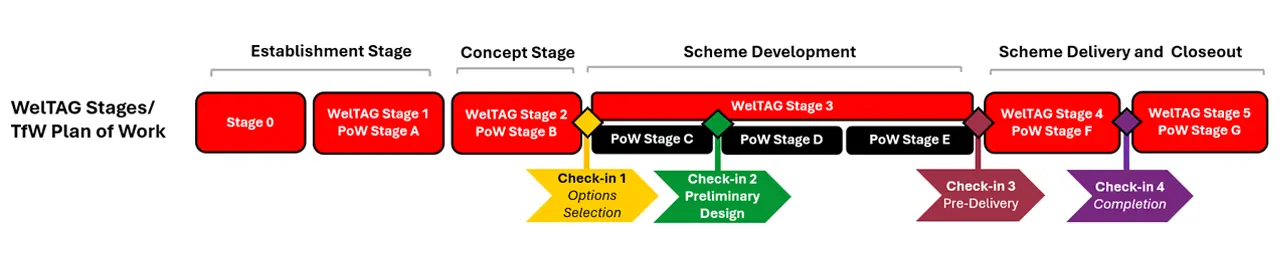
Check-in 1: Options selection
| When | Pre-requisite activities | Documents |
Once a route is selected from the Active Travel Network Map (ATNM), and a single preferred option has been selected.
|
|
|
Check-in 2: Preliminary design
| When | Pre-requisite activities | Documents |
Once a single preferred option has been identified and undergone preliminary design.
|
|
|
Check-in 3: Pre-delivery
| When | Pre-requisite activities | Documents |
Once a scheme is ready for delivery.
|
|
|
Check-in 4: Completion
| When | Pre-requisite activities | Documents |
Once the delivery phase is practically complete and the scheme is in use.
|
|
|
For further detail on the methodology and implementation, readers are encouraged to refer to the recently published TfW Active Travel Advisory / Active Travel Delivery Guidance, September 2025.
-
Station Network PlansNeed support with your SNP projectOur team can help with funding options and technical advice.Contact us